


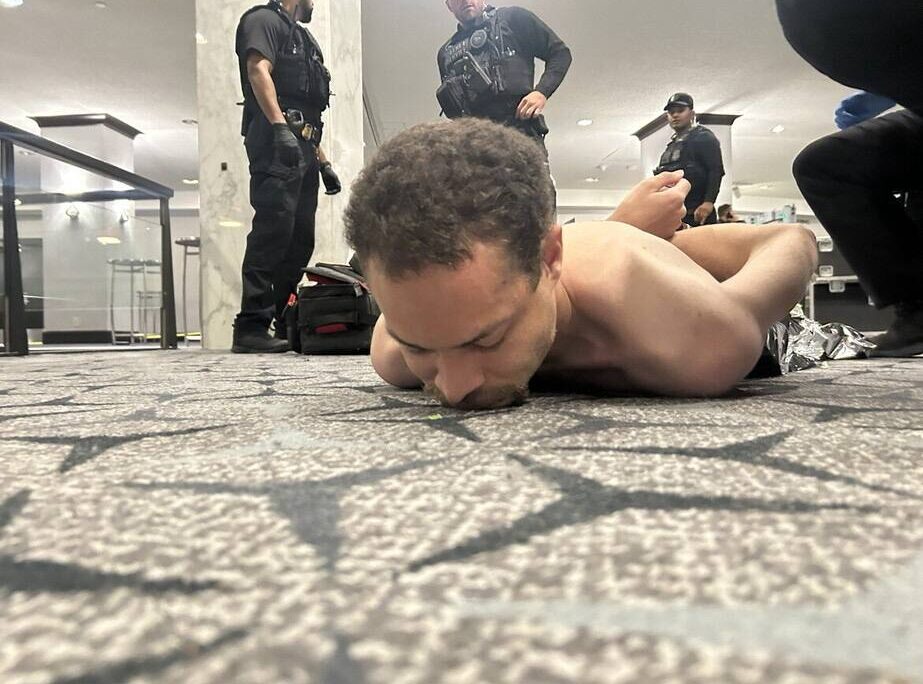
When the first shot rang out in the lobby of the Washington Hilton on Saturday night, U.S. President Donald Trump was already seated at the head table of the White House Correspondents’ Dinner, just a few dozen meters away. Cole Tomas Allen, 31, a mechanical engineer who graduated from the California Institute of Technology and a resident of Torrance, California, had just rushed past a checkpoint with a handgun in his fist. According to the Washington Metropolitan Police, he was also carrying a shotgun and several knives, on his person and in a bag. He fired four or five shots before Secret Service agents took him down, right in front of the door of the room where the President, First Lady Melania, Vice President JD Vance and most of the Cabinet were dining. One agent was hit but was saved by his bulletproof vest. It is the third assassination attempt against Trump in less than two years, after Butler (Pennsylvania, July 13, 2024) and West Palm Beach (September 15, 2024). And, like those two, it tells the story of more than one failure.
The dynamics: the gap was already open
The CCTV footage released by the White House itself within hours of the attack shows the weak point with embarrassing clarity. Allen did not force an active perimeter: he walked through a perimeter that was being dismantled. Once the President had entered the room and dinner had begun, the hotel’s security staff had started to disassemble the metal detectors at the entrance, since latecomers were no longer being allowed in. That is exactly the window the attacker exploited, breaking in at that very moment. The underlying principle — a physical perimeter whose strength varies according to the evening’s program rather than the presence of the protectee — is the first technical flaw of the night.
The failures upstream
Witness accounts collected from guests in the following hours paint a picture that goes beyond the single breach. Several attendees reported that they were not asked to show a photo ID, despite a now well-established standard for events with presidential presence. There appears to have been no cross-check against the guest list. In the hours preceding the dinner, the hotel was hosting a series of pre-event receptions (the so-called “pre-parties”) with inconsistent or absent screening, and guests’ luggage and bags reached the upper floors in many cases without being inspected. A former senior White House official, quoted by the Washington Post, stressed that “there were no checkpoints to get into the hotel” and that the VIP reception adjacent to the ballroom — through which Cabinet members and potentially the President himself were passing — was without a dedicated security apparatus. According to investigators, it is in this interval that the attacker may have brought in a disassembled long gun.
Former FBI Deputy Director Andrew McCabe described the protection package required for an evening of this kind as “almost at the level of a national security event,” given the concentration of protected figures in a single location: President, Vice President, department heads, agency directors. The standard applied on Saturday night, in light of the testimony, was significantly lower. Trump himself, in his post-event remarks, called the Hilton “not a particularly secure building” — an argument he then redeployed to justify the new ballroom at the White House.
The Secret Service’s defense
Secret Service Director Sean Curran held the “defense in depth” line: “It shows that our multilayered protection works. The security plan for the evening was developed by the Secret Service, and that security plan worked.” The argument has its operational basis — the President was not reached, the attacker was neutralized before breaching the ballroom, the agent who was hit was protected by his vest — but it measures success by the outcome, not by the perimeter. The question lawmakers have already started to ask, just as after Butler, is a different one: how is it possible that an armed individual got within a few meters of the door of the room?
The attacker’s profile
Allen’s profile further complicates the reading. No known criminal record, mechanical engineer Caltech 2017, master’s in computer science from California State University Dominguez Hills in 2025, a former teacher recognized as “Teacher of the Month” in California according to Newsweek. He reportedly traveled by train from California to Washington via Chicago, and reportedly sent his family a manifesto in which he criticized precisely the “weakness” of the security at the correspondents’ dinner: “What I noticed walking into the hotel was a sense of arrogance. Security was all on the outside, focused on the protesters. Apparently nobody thought about what could happen if someone checked in the day before.” It is the fourth recent profile of an educated, mobile “lone actor,” capable of autonomous logistical planning and of pre-surveying the target: a pattern the Department of Homeland Security has already flagged as dominant in threats to protectees over the past eighteen months.
What did work
The protective detail’s physical reaction was immediate: the President and Vice President were extracted in times consistent with the manual, the room was evacuated in an orderly manner, and the subject was neutralized before any breach of the ballroom. Individual protection worked. Internal communications held. The Hilton itself, it should be remembered, is the hotel outside which Ronald Reagan was shot in 1981: over forty-five years, agents’ responsiveness on a dynamic event has measurably improved.
Lessons to be learned
The structural problem remains. After Butler, the bipartisan House task force report identified two critical areas: Secret Service–local law enforcement coordination, and perimeter management at “soft sites.” After West Palm Beach, the recommendations focused on the control of external observation points and the timing of sweeps. The correspondents’ dinner falls into a third category — “social events with a high concentration of protectees” — which today depends largely on cooperation with a private host (the hotel) and with a professional organization (the White House Correspondents’ Association). This is exactly the gray space the attacker hit. The operational guidance points in three directions: standardize screening for any event with presidential presence, regardless of the host, with metal detectors active for the entire duration of the protectee’s stay and not only until “seating”; introduce a document check cross-referenced against the guest list, run by the Secret Service and not delegated to the organizer; raise pre-event luggage sweeps to the level required for diplomatic events, with a trackable time window. Building the ballroom at the White House will help solve several of the security issues encountered at private events: in addition to the three directions above, it will provide a perimeter that is already secured and tested, will be designed with the safety of the protectees in mind from the outset, and will eliminate the problem of guests already staying at the hotel.
Curran has promised an after-action review within thirty days. It will be the third in two years. The relevant question, from a security governance standpoint, is no longer whether the system held on Saturday night — it held by a few meters — but how much longer one can keep counting on those few meters.
