


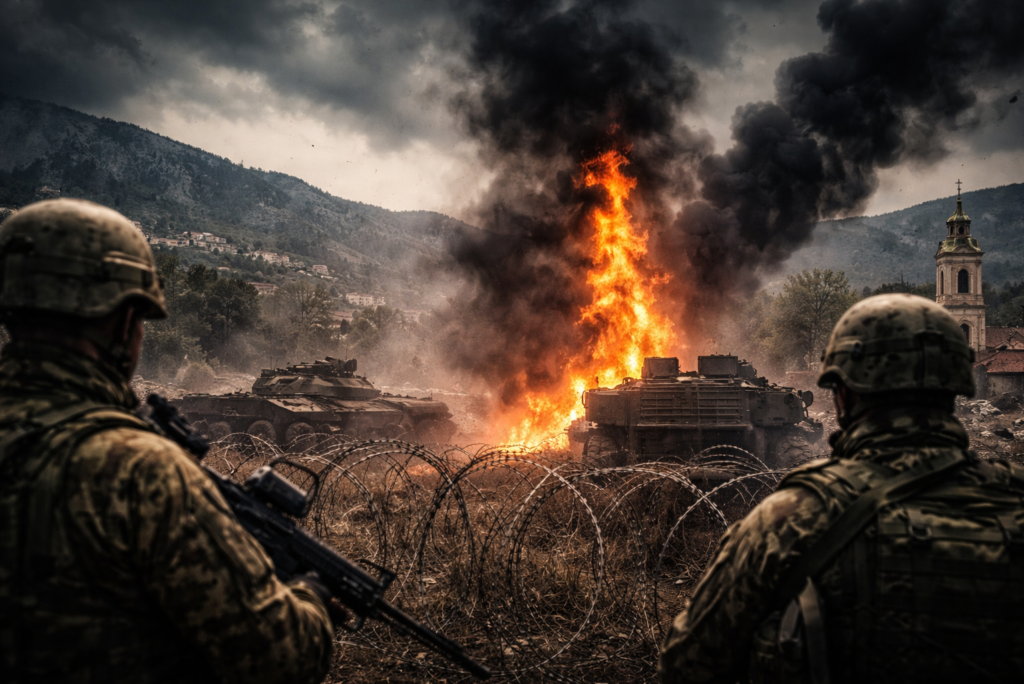
The Western Balkans are experiencing one of the most delicate moments in recent years on the security front. Between March 2025 and the first months of 2026, a new trilateral military cooperation pact has rekindled ancient suspicions, while Belgrade accelerates its rearmament with Beijing and Russian disinformation contributes to polarizing public opinion.The agreement in question was signed in March 2025 between Croatia, Albania, and Kosovo. The ambition of the three countries is to strengthen defence cooperation, and the pact is built on four pillars: enhancement of defensive capabilities and joint industrial production; joint exercises, training, and interoperability; countering hybrid threats (cyber, disinformation, sabotage); and support for Kosovo’s Euro-Atlantic integration.
Full operational capability of the plan has been reached since the early months of this year, with meetings in Zagreb and Shkodër between the chiefs of defence staff of the three countries. They decided to organise three trilateral exercises in 2026. The stated goal is to improve crisis response and resilience to hybrid threats, in line with NATO’s strategic concept.
Although Albania and Croatia (both NATO members) insist on the “friendly” and purely defensive nature of the cooperation, Serbia has not reacted positively. On the contrary, Belgrade has interpreted the agreement entirely through an anti-Serb lens—as a provocation that, according to Serbian officials, even foreshadows the possibility of a joint attack. Croatian Prime Minister Plenković has tried to reassure President Vučić in person, but tensions remain high.
Croatia has long complained about Serbia’s progressive rearmament, especially the purchase of hypersonic missiles from China. As recently as 13 March 2026, Vučić officially confirmed the acquisition of Chinese CM-400AKG air-to-surface missiles (supersonic, with a range of up to 400 km according to Serbian sources), mounted on MiG-29 jets. Serbia is the first European country to possess them. In addition to these, Belgrade has received other Chinese weapon systems in recent years. Today China is the main supplier of heavy weapons to Serbia, which over the past five years has imported more systems than any other Western Balkan country. Not content with that, Vučić has stated that Serbia will double its military capabilities in the next 18 months—prompting Croatia to denounce a new arms race in the region.
Beyond strictly military cooperation, the trilateral agreement also includes measures to counter hybrid threats. This is no coincidence. Disinformation in the region is growing and is being channelled by both regional and global powers. U.S. intelligence services have warned in particular that Russia continues to stoke instability between Serbia and Kosovo and supports the secessionist moves of Milorad Dodik in Bosnia.
Pro-Russian media in the Balkans therefore portray the Croatia-Albania-Kosovo agreement as “preparation for an attack on the Serbs.” The objective is clear: to keep the region unstable, slow NATO and EU enlargement, and preserve Moscow’s influence. Experts and reports are already recording a surge in sabotage attempts, cyber-attacks, and polarising narratives precisely in 2026—a year already marked by rising international tensions. Meanwhile, Russia, China, Turkey, and the United Arab Emirates are competing to expand their influence in the region.
The mix of defence agreements, arms race, Russian disinformation, and still-vivid historical memories makes the Balkans a hotspot that must be watched closely. The EU and NATO could help calm the waters with greater presence, more concrete investment in shared defence, and a clear accession path for those who want it. However, the increase in threats and internal divisions risk complicating the efforts of both organisations and their member states.
The Balkans are not a “periphery”: they are a crucial line of defence in Europe’s security architecture. Ignoring them would be a strategic mistake. History has already taught us that—unfortunately.
